MEMORIAL VOL. 2
We hereby announce the second annual MEMORIAL: The Fall of the University, commemorating the systemic failure of the educational system at the Faculty of Informatics of Masaryk University. This year, it comes in the wake of a scandal involving a university employee allegedly sending sexual private messages to female students under his supervision. Once again, it falls on the symbolic date of 11 September.
As usual, every year we document whether there has been any remedy to the situation identified by the National Office for Higher Education and by the Prague court in 2018.
Our commitment is the same as last year: until the situation is remedied, we will continue documenting it and drawing attention to it. People have the right to quality education, not to a waste of time and resources. It is necessary to understand that attacks on the intellectual layer of our society are unacceptable. Seventy percent excluded at Czech technical universities; 51 percent excluded at non-technical higher-education institutions. The proportion of university graduates in relation to the population of our country is the third worst in the EU. At MUNI, even 100 percent of students in some programmes were excluded, literally with the assistance not only of the university police but also of public officials. The school was stripped of all accreditations in 2018. It is necessary to understand that the school was caught under literally the same legal provisions as those used in past totalitarian regimes. In the joint FI MUNI campus with the lawyers, there used to be Gestapo headquarters, and after the fall of the Third Reich, the Communist Party was renamed the Purkyně University. State examinations there included scientific Marxism and Leninism. This regime cannot learn from the past and throws thousands of people out of the university every year. In this, the regime has surpassed even the totalitarian systems that existed here before. It puts on an arrogant face and threatens people merely for making comparisons — comparisons to the same legal provision under which it itself was caught during the previous regime.
This Memorial was created as a reminder of the horrors that took place at the Faculty of Informatics of Masaryk University between 2006 and 2018, when the faculty was closed because of the mass expulsion of students and hidden practices of its management.
The systemic and direct aggressive methods of the school’s management resulted in the dehumanisation of students, falsification of statistical data and the mass expulsion of entire cohorts. For example, approximately 170 new students in one programme were divided and dehumanised, while only about 10 made it to the end. The school confiscated final theses, together with the copyright attached to them, and to this day sells them under the banner of the university or the state. In every class, therefore, practically everyone failed and was expelled.
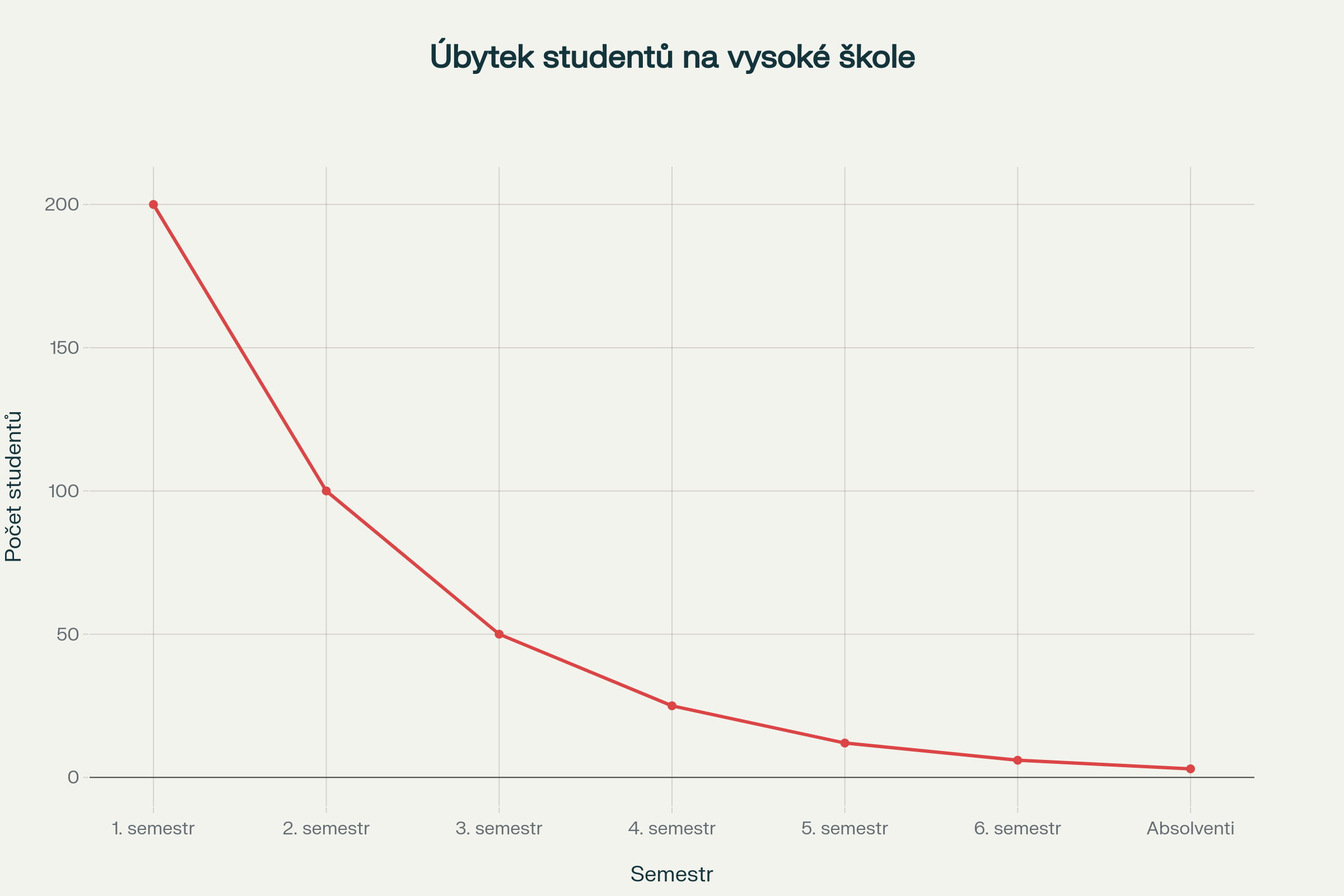
A normalised graph showing the standard geometric progression of students created by the university’s constant unlawful expulsions of students. Truly decent working people will never understand how any academic employee can take a payslip into their hand after such conduct. Let alone continually complain about being financially undervalued. Being in a sect is not a virtue. On the contrary, it is a deeply negative human trait.
The working environment was utterly toxic, violated basic hygiene and safety standards, and created immense psychological pressure that effectively destroyed students’ hope of succeeding. There was systematic gaslighting, brainwashing and dehumanisation, in which students were destroyed both as individuals and as a collective. The school was genuinely caught under the same legal provisions associated with atrocities committed by the two most significant totalitarian regimes of the last century.
This year’s Memorial is shaped by another case at the school. Once again, academics are harassing male and female students, and it has even reached the national press. And it now appears that someone may actually deal with it. A university academic employee writes private messages to female students under his supervision. Some allegedly have sexual undertones or are openly sexual. And someone is going to investigate him? For years, we have drawn attention to sexual misconduct by university employees who have inappropriate relationships with students, female students or people under their supervision. Informal familiarity, going for beers together, even having children with female students. And further absurdities that do not belong in an academic environment — or even on academic grounds. Today, someone has latched onto one case and will address it. We are talking about a school where it was normal to throw out even 100 percent of students in a programme without oversight. A school over which the accreditation commission for higher education was dissolved and all 21 members of that commission were dismissed. Only a fraction went to prison, mainly a deputy minister and a deputy minister. Someone ensured that the chairwoman’s case continues to disappear into oblivion, despite evidence suggesting that the FI MUNI case was clearly corrupt. It is also surprising that at a school with a ratio of 12 men to one woman, it is once again a woman who is harassed. That male vanity: “I have everything sorted.” Terrible. And are men, when there are twelve of them to one, therefore not harassed? The case shows the alibi-driven nature of the Czech policing environment and the complete disregard of the executive branch of this state for Article 14 of the Treaty of Lisbon on the right to education, from which it is clear that students must have a sufficient chance to complete their studies. Otherwise, a school should not have accreditation. And let us not deceive ourselves: if that chance is not respected, it is dehumanising abuse on a massive scale.
Masaryk University, in relation to the withdrawal of all accreditations in 2018 and the subsequent introduction of only primitive programmes so that FI MUNI’s constructed buildings would not collapse into themselves through decay, once again demonstrates that the university police are the personal security detail of the management and have nothing in common with a security force. As for the old case, even despite a Constitutional Court decision in which the GIBS was sued over allegations that it and the Police of the Czech Republic literally steal files concerning attacks at Charles University, everyone at MUNI in Brno seems indifferent to the fact that they should hand over personal-data files under the data-protection law and at least begin somewhere. Thus, historically harmed students presumably do not have their files. Neither the part held by the police nor the part held by the school. This is so even despite a valid constitutional decision stating that the files should be handed over as quickly as possible. Why deal with a valid constitutional decision? It is apparently preferable to write private messages to female students under one’s supervision, some with sexual undertones, and let old mates write articles about us because they love us so much. We know that the school systematically covers up harassment. That is what this entire series is about.
Assessment for 2026: as is clear from the above, neither the school nor the Police of the Czech Republic, after losing at the Constitutional Court, intend — on the basis of Article 42 of the Treaty of Lisbon, the principle of good administration and the constitutional decision — to hand over files to historically harmed students. How are we meant to reach any real enforcement of rights when, in this post-communist environment, a pile of files can simply be made to disappear? Some were found in Operation Stoka. Yet the National Office did not give them to their owners. And let us not be surprised that MUNI was once the 52nd-best university in the world and is now somewhere around 500th place. If, in 2006, the thinking of communist apparatchiks returned with Mr Fiala, then a file exists so that five chosen people may see it. And above all, nobody resolved anything. The police look away the whole time, or can shift the blame to their commander, the National Office for Combating Organised Crime. Some files are there, and they are doing well there. Because that is simply where they are supposed to be. Therefore, the assessment for 2026 is: 0 percent achieved — and someone sexually harasses you in the process. Therefore: F — failed.
As follows from the series, every would-be big shot from the school went looking for parliamentary immunity. And thus a department of a public school, which is not the state and should have nothing to do with the state, is once again being influenced by state employees from Parliament. And as it usually goes, when we want to return to an “equal” system and adopt the mentality of the 1980s, our non-academic staff in this education system are, or may already be, employees not of the school but of the state. So is the woman serving food in the school cafeteria actually a state agent? The return of the StB in full force. Perhaps someone will recruit them. Today, during the war in Russia — pardon me, in Ukraine.
And we also come to my local scandal, where Mr Zácha, the deputy responsible for education, is slowly bringing the Autostráda case to its conclusion. A prosecutor from the High Public Prosecutor’s Office (VSZ) in Olomouc charged eight people and one company in a case involving allegedly manipulated transport contracts in the Olomouc Region. The Autostráda case will be heard by the Regional Court in Olomouc, according to the public prosecutor’s office. That is great. Mr Michal Zácha was not only a deputy responsible for transport. He was also a councillor in Přerov and was responsible for education. In other words, for his own pocket. So how is it possible that no one from Přerov has had access to their file to this day? Article 42 of the Treaty of Lisbon and Act No. 106/1999 Coll. exist only so that we look good in the West. Yet anyone who had an ID card from Přerov still does not have their file to this day. So I would like to know whether the public prosecutor’s office really deals only with bricks stacked on top of one another and land covered in asphalt. Or whether it could also deal with schools, where nothing moved under people like these.
State subsidies will continue to go to a school that will never provide these services, and they will still force you to put CZK 10,000 into the SIPO payment system every month, because education in the Czech Republic is supposedly free forever. As a matter of principle, we cannot then have an educated society. That is because someone might discover what these fraudsters are doing. And they do not want that. The important thing is to make fools of people.
And while we are on the subject of those politicians, where everyone went looking for parliamentary immunity and wants political change: as every year, just look at the graph attached to this article. You do not need to open the entire series. Then we will turn to a globally recognised definition of one unpleasant act:
“Anyone who threatens adolescents with harm or other violence, doing so with the aim of instilling fear, coercing political decision-making, or advancing political change, commits an exceptionally serious act of a terrorist nature.”
Such conduct is particularly reprehensible because it exploits the safety and protection of adolescents as a means of achieving a political objective.
That is indeed a globally recognised definition of a terrorist attack.
So, no problem, dear relatives, parents, friends and dear public. I admit 176 people to the first year of university. In the second year, there will be 44 of them, and 22 by the penultimate semester before final examinations. After the final semester, 11 will remain. But I do not like them, so I will not allow half of them to take their final examinations either; I will throw them out of the school. I will allow six people to take the final examinations. But beware: I am in a political party and I have my political programme — one that probably cannot be fulfilled. So at the final examinations, we will throw out at least three of the six students as well. Then we will give degrees to the final three. Because someone might put it in the newspapers, and someone might even read them. And we might look like terrorists. But if I could, I would throw everyone out. And we do not refund money for services. Political change has to feed on something.
_______________________________________________________________________________________________________________________________________________
“We are not starting from the beginning.
Another year has come around.”
And I return once again to a subject to which I have already devoted several articles, graphs, time series and personal testimonies. Not because I need to repeat what has already been said. We return to it because a problem that has once been described does not disappear simply because people stop talking about it.
This text is the second annual edition of the Memorial: The Fall of the University. It is not a new beginning. It is a continuation.
In the first part of the Memorial series — as the author’s note explains, it is part of an endless series concerning the MUNI scandals — I addressed degree programmes, the numbers of entering students and the numbers of those who reached the final semesters of the standard period of study. In the second part, I returned to these figures mathematically and graphically. In the third part, I opened the issue of projects, authorship and the handling of the results of work. In the fourth part, I addressed specific individuals and responsibility. The fifth part then closed the original series with an overall summary.
But closing a series is not the same thing as remedying a problem.
That is why the Memorial was created.
Why the Memorial continues
The Memorial is not a celebration of the past. It is a reminder of what, according to my previous series, has remained unresolved.
In earlier articles, I described an environment in which, according to the submitted graphs and calculations, major differences appeared between the number of admitted students and the number of students continuing into the final semesters. At the time, I described these differences as a question of students’ real chance of completing their studies.
This was not merely about an individual student who failed one examination. It was about broader trends.
About cohorts.
About degree programmes.
About numbers that kept repeating.
About students who entered the system but, in the final statistics, appeared only as failures, withdrawals or exclusions.
Graphs instead of excuses
A graph has one fundamental quality.
It cannot become tired.
It cannot forget what happened in the previous academic year. It cannot change its testimony according to who is asking at any given moment. If it is correctly created and based on truthful data, it shows a development that cannot be hidden behind a press release.
In the first part, I therefore compared the number of students who entered a programme with the number of students who reached the final semester of the standard period of study. I described this difference as “chance,” and its complement as “difficulty.”
My aim was not to claim that every student must complete university regardless of their own work. My point was something else.
If a high number of students are admitted over the long term and, at the same time, only a fraction advance to the final stage, the institution must ask whether the problem lies solely with the students. Or whether the system of teaching, selection, assessment and support also bears part of the responsibility.
Expulsions as a statistical method
In the previous parts, I returned to the fact that, in some degree programmes, my analysis indicated an exceptionally high rate of student departure. In certain cases, I also worked with the assertion that the number of excluded or unsuccessful students approached the total number admitted.
That is not an ordinary detail.
If a school admits students, provides them with teaching and subsequently removes most or all of them from their studies, it must be possible to explain publicly what exactly happened. It is not enough to say that the programme was demanding. It is not enough to say that students did not meet their obligations. It is not enough to show the final number of graduates.
The entire process must be shown.
How many students were admitted.
How many successfully completed the first year.
How many continued into the following year.
How many students ended their studies voluntarily.
How many were excluded.
How many were recorded as unsuccessful.
And above all: who bore responsibility for this system.
In earlier texts, I asked how an educational system can function in a situation where it removes almost all students from their studies.
I repeat this question today.
I am not saying that every departure from university is evidence of criminal conduct. I am not saying that every failure arose through the fault of a teacher. I am saying, however, that where a pattern repeats over the long term, there must be an answer.
Who monitored the quality of teaching?
Who monitored the statistics?
Who assessed whether the conditions in place were achievable?
Who evaluated whether students were receiving a genuine chance to succeed?
And who decided that the system would continue in the same way as before?
In my previous series, I described how, in my view, these questions were not answered sufficiently. That is why I return to them.
Not for sensation.
For accountability.
What remained after accreditation
I also connected the original series to the question of accreditation and to decisions that, according to my account, were meant to substantially affect the school’s subsequent operation.
In the articles, I described my view of what happened in the period before 2018, what followed the interventions of accreditation authorities and whether the subsequent remedy was genuine or merely formal.
Today, I ask again:
What changed?
Were the study conditions changed?
Were the degree programmes reassessed?
Were complete statistics published?
Were historically harmed students informed?
Were consequences drawn against people who, according to the previous articles, bore responsibility?
Documents and silence
In every similar story, documents carry the same weight as testimony.
Without documents, an investigation becomes one claim against another. Without the ability to inspect the underlying materials, an injured person can seek redress only with difficulty. Without a transparent explanation, room is created for doubt.
That is why, in previous articles, I repeatedly raised the issue of documents, personal data and files concerning historical events and specific students.
If the release of a document is refused, it must be clearly stated why. If certain parts are redacted, the reason for doing so must be explained. If a document is refused in its entirety, there must be an opportunity for review.
Otherwise, the right to information becomes merely a theoretical possibility written on paper.
Why I mention students again
The centre of the entire Memorial is not institutions.
It is students.
Students who began their studies believing that they would receive an education. Students who invested time, money and energy in the school. Students who subordinated their personal lives, work and family plans to their studies.
When a system fails, a student usually does not have the same strength as an institution. A student has no legal department. No apparatus. No access to all documents. No ability to appear before the public at any time and explain their own position.
That is why the Memorial has meaning.
Not as personal revenge.
As a reminder of the imbalance between the individual and the institution.
What led me to this year’s edition
This year, I again encountered information concerning the safety of students and potential inappropriate conduct in an academic setting.
A specific case in which, once again, an academic employee at the university writes private messages to female students under his supervision. He invites them to “sexy little things,” and so on. And he writes obscene messages.
Such matters bother me even when a university employee teaches sexy partner dancing on university premises and believes that gives him the right to write private messages to women and make private visits to women in couples. The dance is sexy, after all, so why not be sexy? Who could possibly mind? No one. But there is another series about dancing. We are dealing with something completely different: ethics. Responsibility. Good morals. Not bringing drugs onto university grounds, and so on.
For this year’s Memorial, something else is more important.
The new information reminded me again that the question of student safety is not separate from the earlier themes. When an institution ignores warning signals over the long term, a problem arises regardless of whether it concerns graphs, expulsions, documents, authorship or interpersonal relationships.
That is why I return to the old articles.
That is why I publish the graphs again.
That is why I recall the expulsions again.
That is why I ask again who monitors those who are supposed to monitor the school.
It is not one incident
I do not want this year’s text to read as an article about one specific case. It is not.
It is a revisiting edition.
Its purpose is to remind readers that the previous series was not built upon a single event. It was built on long-term monitoring of figures, procedures and decisions.
The first part was about degree programmes.
The second part was about the mathematical picture of development.
The third part was about projects and copyright.
The fourth part was about specific actors.
The fifth part was about the summary.
In the subsequent text, Free School, Fraudulent School, I attempted to describe what, in my view, followed the original series and whether the system truly changed.
And the Memorial is a reminder that the question of remedy cannot be solved merely by announcing that things have improved.
Conclusion
After several years, I return to the same place where the entire series began.
To students.
To graphs.
To numbers.
To the question of whether an institution provides a genuine chance to study, or merely formally opens its doors so that it can later report a high number of unsuccessful students.
I am not saying that every teacher is responsible for every failure. I am not saying that every problem is automatically a criminal offence. I am saying that a system that repeatedly produces the same results over the long term must be willing to explain why that is the case.
And if no explanation comes, space is created for the Memorial.
Not to inflate the past.
But to ensure that it is not forgotten.
I therefore conclude this article with the same question as in the previous parts:
When will remedy become real, and when will it cease to be merely a word?
Finally, a few statistical figures and legal provisions from the previous year.
Country
Share of university graduates (%)
Rank in the EU
Ireland
54.0%
1st
Austria
36.0%
Middle
EU average
37.7%
–
Poland
34.0%
10th
Slovakia
29.0%
24th
Czech Republic
26.7%
27th (third worst)
Romania
20.0%
28th
Italy
20.0%
29th worst
Article 41 of the Treaty of Lisbon and the systemic violation of citizens’ rights by the Police of the Czech Republic
The Czech Republic has, over the long term, violated fundamental European standards concerning access to documents and the protection of personal data, while the Police of the Czech Republic systematically disregard both Article 41 of the Charter of Fundamental Rights of the European Union and the GDPR. This situation constitutes a serious violation of European law and has devastating consequences for victims of criminal offences, who are thereby deprived of their fundamental rights.
Article 41 of the Charter of Fundamental Rights of the European Union: The right to good administration
Article 41 of the Charter of Fundamental Rights of the European Union establishes the fundamental right of every person to access their file, while respecting legitimate interests of confidentiality and commercial secrecy. Specifically, Article 41(2)(b) provides:
“the right of every person to have access to his or her file, while respecting the legitimate interests of confidentiality and of professional and business secrecy”
This right is an integral part of the right to a fair process and represents a fundamental building block of democratic administration in the European Union. The Treaty of Lisbon significantly strengthened transparency and extended the scope of this right to all institutions, bodies, offices and agencies of the Union.
Violations of rights by the Police of the Czech Republic
Systematic denial of access to files
The Police of the Czech Republic routinely refuse to provide victims of criminal offences with access to their own files, even though this right is clearly guaranteed by both European law and Czech legislation. Under the Czech Act on Victims of Crime, victims have the right to:
inspect the file and make notes or copies from it at their own expense
request information on the status of criminal proceedings, except where doing so could jeopardise the purpose of the proceedings
be informed of the final decision that concludes criminal proceedings
Despite these clear legal obligations, the police routinely ignore or reject such requests without proper justification.
All parts of the series discussed in this article:
Want the background? Read my five-part journalistic series about the closure of the Faculty of Informatics.
All rights reserved: This content is protected by copyright law.
Part One of the FI MU vs. Coronavirus series — Part 1.
The first episode introduces the compositional chronology of the entire scandal / first episode of the series is about the chronology of the scandal.
Part Two of the FI MU vs. Coronavirus series — Part 2 (Czech) / Part 2.
The second episode provides an in-depth examination of selected degree programmes / second episode of the series is about the vertical levels of statistics and alleged university misconduct.
Part Three of the FI MU vs. Coronavirus series — Part 3 / Part 3.
The third episode concerns the alleged theft of the university archive and the failure to hand over files and proceeds after the tribunal that took place / third episode is about the alleged manipulation of the university archive and a purportedly improper tribunal without providing files to victims.
Part Four of the FI MU vs. Coronavirus series — Part 4 / Part 4.
The fourth episode introduces who is who in the FI MU scandal / fourth episode is about the principal actors in the FI MU scandal.
Part Five of the FI MU vs. Coronavirus series — Part 5 / Part 5.
Kiclus Home Page (summary article — the final separate part).
Last year’s Memorial, VOL. 1:
https://www.tomaskacel.eu/books/memorial-p--d-univerzity.php
Mgr. Bc. Tomáš Kácel,
tomaskacel.eu
11 September 2026, Domaželice
All rights reserved. This content is protected by copyright law.