Catastrophic Communication with the Přerov Traffic Department
Personal experience of a property owner with the labyrinth of Czech public administration — a story about a construction project that turned into a trap, about a traffic sign that makes no sense, and about officials who answer questions that nobody asked
When a sidewalk renovation changes your life
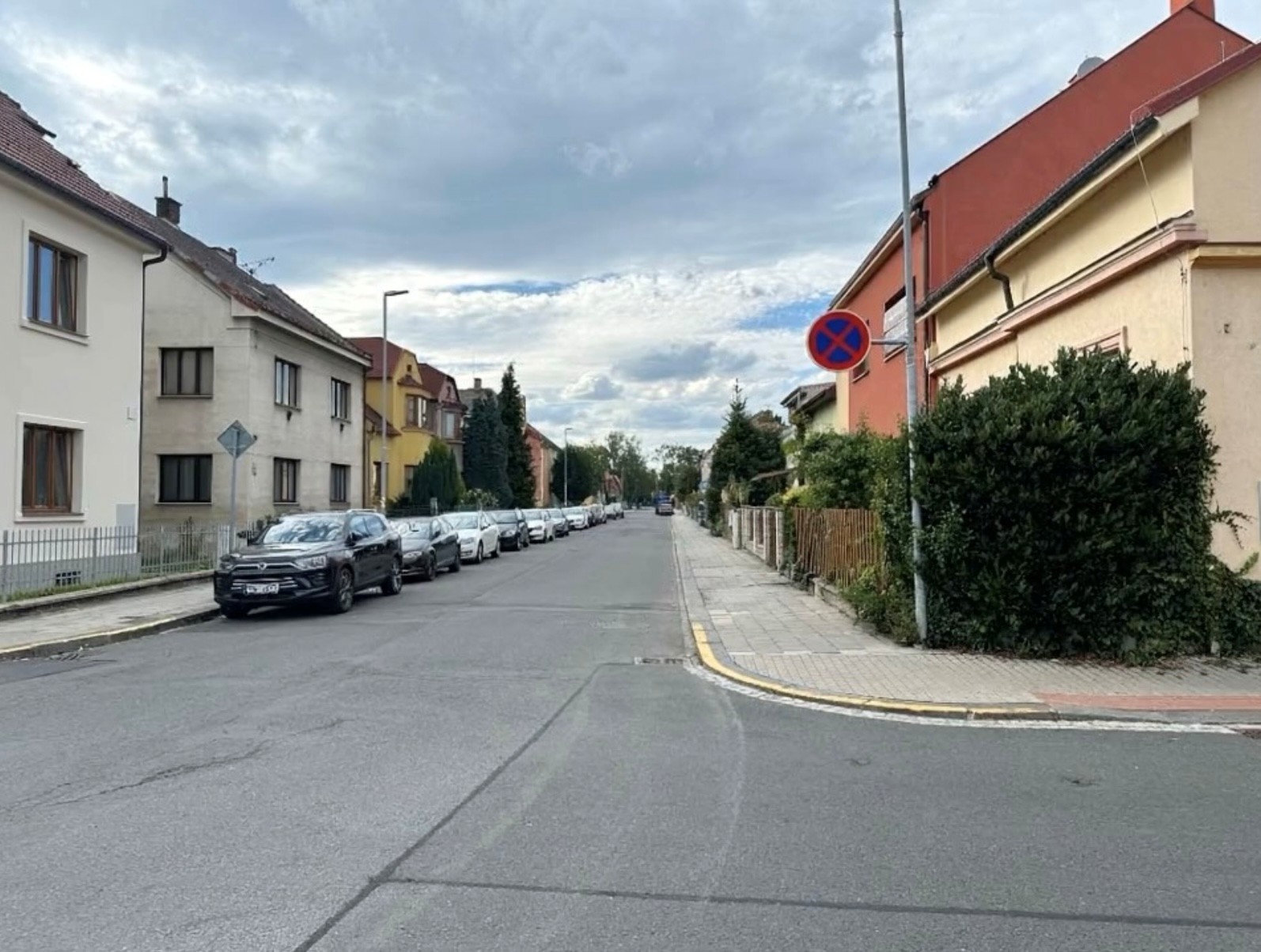
There are things you do not expect when you agree to have the sidewalk in front of your house reconstructed. You expect dust, noise, months of a construction site and then — hopefully — a nice new surface. You do not expect that from one day to the next you will find yourself in a situation where access to your own basement, including a room with a garage, is practically blocked. You do not expect that the authorities will assure you that you agreed to all of this. And you certainly do not expect that the fight to correct an obvious absurdity will take years
This is another of my stories about dealing with aggressive officials — this time as the owner of a corner house on a street in Přerov. It is not just about one sign on one street. It is about the system — about how public administration communicates (or rather fails to communicate) with citizens, about how the law is bent in favour of formality over common sense, and about what happens when a person refuses to accept absurdity as normal.
Reconstruction, agreement and paving blocks — a story of good beginnings
Goodwill on both sides
It all started as a standard public works project. The city of Přerov decided to reconstruct the sidewalks in front of my house. The owners of adjacent properties, myself included, agreed to the work and actively cooperated. Communication with the site manager went on for months — not formally through the official notice board, but through direct, practical arrangements on site, the way it is usually done in such situations (all of which the site manager is supposed to record in the construction logbook, which is the property of the city)
Part of the reconstruction was the reinforcement of a section of the sidewalk with interlocking paving blocks. Not by accident — specifically so that vehicles could drive onto it, so that it could serve as an access platform, and so that, as before, the owners could park there. This section was deliberately designed and built to allow vehicles to drive in. As a direct and logical supplement to this purpose, ramped bollards were installed on the side of my house and the neighbouring properties — low, allowing vehicles to drive over them and partially onto the sidewalk in order to keep the carriageway safely passable for traffic.
A key fact that will play a role throughout the entire story: on the opposite side of the street, new tall bollards were installed — the kind you simply cannot drive over. In other words, from a construction and physical point of view, this street was designed and built with a clear intention on which side vehicles would pull in, stop and park. The ramped bollards on the side of Svépomoc III are not a coincidence. They are a design decision.
Months of construction, months of agreement
For months there was a building site in front of my house. For months, there were consultations, clarifications of details, approvals of procedures. Who was present? The site manager. Representatives of the city. And the homeowners, who watched day after day as their street changed its shape.
This direct, factual and provable communication is crucial. It did not arise from any notice on a bulletin board. It arose from the everyday reality of the construction — from what is being built, how it is being built and why. The result was clear: a reinforced sidewalk, an access platform, low ramped bollards. The physical appearance of the street expressed the agreement of both sides better than any form.
From one day to the next — how supplying the basement and garage became impossible
The sign that appeared without warning
And then it happened. Without discussion. Without prior notice. Without a letter in advance. Without a single conversation with the owners of the affected properties.
On the newly reconstructed street, a traffic sign B28 — No stopping appeared. And not just on a short section near the bus stop. The entire street Svépomoc III — from the intersection onwards — was covered by this sign. Exactly the section where the ramped bollards had been installed. Exactly where the reinforced paving by its very physical nature says: this is where you pull in, this is where you enter the garage.
The absurdity of the situation is geometric: the ramped bollards were physically installed so that vehicles could drive over them and park. The No stopping sign prohibits the owners’ vehicles from stopping there at all. The city quite literally built infrastructure for stopping and then, with its own hands, banned stopping in that very place.
Section 2(o) of the Act defines stopping as:
“to stop means to bring a vehicle to a standstill for such time as is necessary for the immediate boarding or alighting of persons being transported, or for the immediate loading or unloading of cargo.”
Section 2(p) of the Act then defines a stopped vehicle as:
“to stop a vehicle means to interrupt driving for reasons independent of the will of the driver.”
The only theoretically remaining legal option is precisely Section 2(p) — a situation where the vehicle stops for a reason independent of the driver’s will. In other words: a breakdown, a traffic jam, an accident. This clause truly exists — and paradoxically it is the only formal legal lifeline for owners who want to stop in front of their own garages on a street where ramped bollards were deliberately installed. It is absurd but true: the only “legal” way to supply your own basement and garage is to stop as if your car had broken down. Including supplying the boiler room in the house and other essential needs of the property.podnikatel+1
The Czech legal system guarantees rights attached to property, such as the right to supply and access it. The primary permitted function of a local road according to zoning plans is precisely that it serves as an access road for the owners of adjacent properties, so that they can supply them, drive home and live there. For this reason, such a road should not be under a No stopping regime in front of residential houses where people live. The road was built by law because houses are there. And for this reason, these access rights are granted as intangible rights attached to the property. From our point of view as complainants, officials are deliberately obstructing the servicing of the properties and violating the owners’ rights. So the question is: how can such owners be tricked, in a democratic country, into effectively giving up these rights to their property? And how can the authorities then impose almost total bans wherever they see fit?
“It was on the official notice board” — an argument that adds insult to injury
An argument that defies logic
When I started dealing with the authorities, I got the classic answer. The Přerov City Hall, Department of Traffic Administrative Agendas, told me what every surprised citizen hates to hear most: the proposed change in traffic signage had been posted on the official notice board, it was possible to comment on it, I did not use this possibility, and therefore there can be no talk of any mistake on their part.
This argument is formally correct. But in substance it is absurd.
Why? Because the direct, physical, everyday communication with the site manager over months — communication that led to the construction of the ramped bollards exactly on the side where homeowners park — is a much stronger proof of knowledge and consent than reading a text on a notice board. The city knew who lives on the street Svépomoc. The site manager knew exactly whose garage opens onto Svépomoc III. If the intention was to build ramped bollards and at the same time ban stopping there, someone had a duty to explain this contradiction. That never happened.
More importantly, the local residents had approved the original plans. So in all records it should be clear that the residents want to continue parking there and do not wish to give up their rights. Instead, the official simply told the citizen a lie: that they “did not know” that I opposed the sign. Officials were present at the construction and therefore cannot credibly claim that “no one said anything”. The only way to later claim that the homeowner voted to give up his rights is to hide these crucial facts.
If the officials had bothered to reconstruct the chronology of events, they would immediately see that the owners never wanted any ban. I am convinced they actually knew that — and concealed it. In doing so, they used my “voice” in the process about us, without us. What should have been subject to public comments was the entire logic of the measure. The claim that “no one commented” is an abuse of the law.
Analogy: a chimney built to be demolished
Imagine someone comes to your land and for months builds a tall chimney — with all necessary permits, with your active cooperation on the project, with your agreement at every stage of the construction. And then, on the day it is finished, they show up with a document from the official notice board and say: “Here is a measure stating that the chimney may not be used. It was posted. You did not comment. That means you agreed.” And then they proceed to demolish the chimney
That is an exact parallel to the situation in Svépomoc Street. The physical infrastructure (ramped bollards, reinforced paving) was built with your knowledge and for your purpose. The legal superstructure (No stopping) has, from one day to the next, nullified that purpose — and the procedural argument “it was on the notice board” has become a shield behind which this absurdity hides. In reality, however, the officials knew perfectly well that we disagreed with the change.
A law that should protect dialogue — but not in Přerov
Section 77(1)(c) of the Road Traffic Act (in conjunction with Sections 171 et seq. of the Administrative Procedure Code) indeed allows local traffic regulation to be established by a measure of a general nature, which must be preceded by a phase in which people can submit comments. This is a correct and democratic procedure. The problem arises when the procedure is used purely formally — as a tick-box exercise, not as a real consultation.
The Olomouc Regional Authority itself admitted in its response of 15 April 2025 that the Přerov City Hall made a mistake — it failed to sufficiently justify the placement of the B28 sign in the measure of a general nature. The region thus indirectly confirmed that the whole process was conducted in a way that creates doubt.
But then the region added: the deficiency in reasoning is merely a procedural defect. The sign itself is legitimate because it serves the “public interest” — the safe access of city buses to the bus stop. And with that, the region considered the matter closed. In other words: after several complaints, the state found that the measure was flawed — but it will continue to block the necessary servicing of the properties anyway.
MHD above everything else
The Olomouc Regional Authority, in its letter of 15 April 2025 (ref. KUOK 47877/2025), explained why it considers the B28 sign on Svépomoc III to be justified:
“In the view of the Regional Authority it is entirely obvious why this measure was adopted — to enable city buses to reach the stop safely and smoothly in their direction of travel.”
According to the region, a local road, under Section 19 of the Roads Act, is intended for general use and adjacent property owners cannot demand the right to park and use the road solely for their own purposes.
This is at odds with the actual premise of the case. Nobody is asserting a special exclusive right. On the contrary — the city has confiscated the entire space for buses and given public transport a one-sided advantage.
In our view as complainants, that is exactly what the city is doing: granting itself a unilateral advantage.
Section 19 of the Roads Act says that a local road is for general use (and is built precisely because houses are there), and municipalities cannot demand the right to park and use the road exclusively for their own needs. In this case, however, it is the city that is using the road only for the needs of buses and stripping the property owners of their rights attached to their homes.
The ramped bollards are not a private investment by the homeowner. They were built as part of a public reconstruction project. Their existence reflects the city’s design intention. And that intention cannot reasonably be interpreted to mean that the city both wants and does not want vehicles to stop in that place at the same time.
Public interest in MHD: genuine or just a pretext?
There has been a bus stop there for 30 years and nobody has ever been restricted in such an extreme way that public transport would receive a unilateral privilege over residents.
No one at city hall seems to have seriously asked — or at least not publicly — a simple question: is a total No stopping ban on the entire section really necessary to ensure smooth bus traffic? Couldn’t less invasive measures work — such as a No parking (B29), time-limited restrictions, or a precisely defined section?
The measure of a general nature was adopted formally, with minimal justification (which the Regional Authority itself labelled insufficient), and the result is the harshest possible restriction (No stopping) in a place where the physical reality of the street says the exact opposite.
Act No. 106/1999 Coll. and the official who replies without answering
The law that guarantees the right to information
Act No. 106/1999 Coll., on free access to information, is one of the cornerstones of transparent public administration in the Czech Republic. Its intent is simple and fundamental: every citizen has the right to ask any public body about its actions, and that body has a duty to answer.
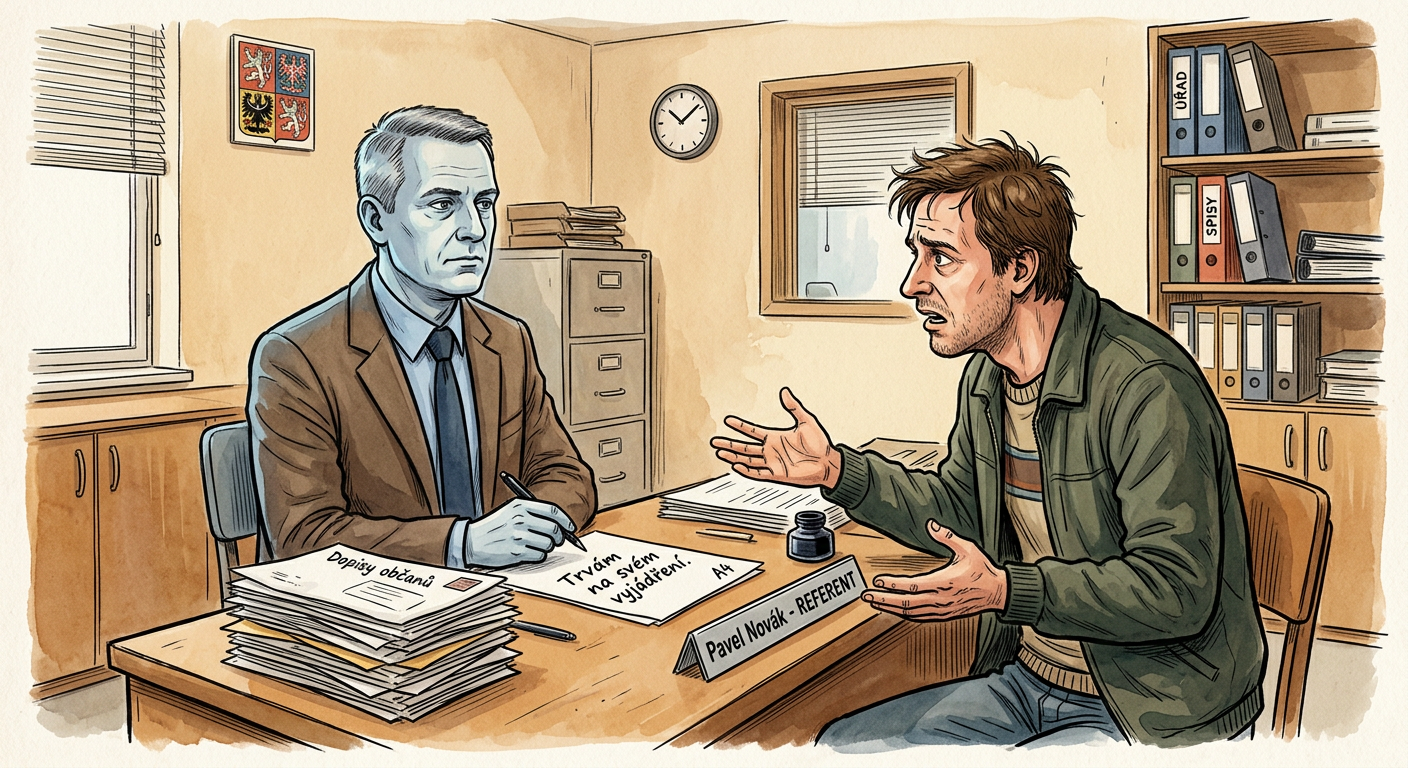
Not to refer back. Not to repeat its previous position. To answer the question actually asked.
The law states that obliged entities — state authorities, local governments, and public institutions managing public funds — must provide information relating to their sphere of competence. The answer must be substantive, must address the question raised and must be provided within the statutory time limit.
So what happens when an official, instead of answering a concrete question, writes: “I stand by my previous statement”?
Quite simply: they have failed to fulfil their legal obligation. Act No. 106/1999 Coll. does not allow an authority to answer different questions than those posed. It does not allow it to simply refer to previous correspondence instead of giving a substantive answer. And it certainly does not allow a one-word or curt refusal without reasoning.
The right to good administration — Article 41 of the EU Charter of Fundamental Rights
This matter goes beyond Czech law. Article 41 of the Charter of Fundamental Rights of the European Union (part of the Lisbon Treaty) guarantees everyone the right to good administration:fra.europa+1
“Every person has the right to have his or her affairs handled impartially, fairly and within a reasonable time by the institutions, bodies, offices and agencies of the Union.”
This right includes in particular:
- the right to be heard before any individual measure which would affect him or her adversely is taken
- the right of access to his or her file
- the obligation of the administration to give reasons for its decisions
The Olomouc Regional Authority, in its decision of 15 April 2025, explicitly admitted that the city of Přerov failed to meet this third requirement: the measure of a general nature was not properly reasoned. This is a direct breach of the basic principle of good administration — and yet the region labelled this defect as “procedural” and without any impact on the validity of the sign.
Passive-aggressive communication by the authorities — symptoms in the Svépomoc III case
Communication in the Svépomoc III case shows exactly these traits:
- Answering different questions. The Přerov City Hall responded to Tomáš Kácel’s complaint by treating it as a request for information under Act No. 106/1999 Coll. and sending a copy of the measure establishing the sign. The original substantive complaint about a logical nonsense (ramped bollards + No stopping = absurdity) remained without a substantive answer.
- “I stand by my statement.” Instead of a reasoned response, there came a curt reference to the previous opinion — with no new arguments and no reaction to the new facts presented by the complainant. Such a response does not meet statutory requirements, but it exists on paper and thus “closes” the file.
- Shifting responsibility onto the complainant. The argument “you did not use the opportunity to comment on the measure of a general nature” implicitly says: your situation is the result of your own inaction. Yet the months of active communication with the site manager clearly show the opposite — the complainant was involved all along, just not in the “correct” formal way.
- Admitting a defect without remedy. The Region admitted a procedural defect but refused to draw any consequences from it. In effect, it said: we made a mistake, but it changes nothing. Such an approach undermines the basic logic of administrative law — procedural defects are supposed to have consequences precisely so that procedures are not an empty ritual.
Escalation that should never have been necessary
Chronology of submissions
The case of Tomáš Kácel shows a typical trajectory of a citizen’s clash with the authorities:
| Date | Step |
|---|---|
| 20 Jan 2025 | Complaint about improper street signage — first written communication with the authority |
| 5 Feb 2025 | Přerov City Hall responds — treats the matter as a request for information, sends the measure |
| 3 Apr 2025 | Request to apply measures against inactivity (§ 80 Administrative Procedure Code) to the Region |
| 15 Apr 2025 | Region responds — admits a procedural error but upholds the sign as legitimate |
| 23 May 2025 | Reply to the Region — disagreement, presentation of further arguments |
| 23 Jun 2025 | Region closes the case — “we refer to our position of 15 April” |
I then took the case to the municipal police station and discussed it in an office with a municipal police officer on T. G. Masaryk Square. Why? Because of course the municipal police fined me for standing in front of my own house in a No stopping zone. The fact that things do not magically teleport themselves into or out of a house is apparently not considered an argument — but logically, a car has to be there.
The escalation did not take weeks. It took more than half a year. And the outcome is not a solution — the outcome is a closed case in which the state legitimised its own logical error by pointing to formal procedures.
The case will drag on for years
If Tomáš Kácel refuses to accept this outcome — and there are good reasons for that — he still has options. A review procedure under Section 174 of the Administrative Procedure Code can be initiated within three years of the measure of a general nature taking effect. At the same time, it is possible to file an administrative lawsuit. Or to turn to the Public Defender of Rights (Ombudsman), who investigates inactivity and maladministration by authorities.
Each of these paths means further months or years. Each is burdensome, financially and mentally. And all that time, in Svépomoc III, the ramped bollards physically say “this is where you drive in”, while the sign next to them says “you must not”.
For the authorities: what should be done differently
This case is not meant to be about “evil officials”. It is about systemic failure of processes.
At the same time, the broader context sheds light on investigations in the road administration sector, which has been controlled by corrupt figures like Michal Zácha, and on the Autostráda scandal involving senior officials in road management. For me, the peak was a phone call in which top people from the Olomouc road administration verbally abused me instead of addressing the problem — insults instead of solutions.
- Consultations with affected persons must be real, not formal. If there has been live communication with the site manager for months, it is unacceptable for the final outcome to be the exact opposite of what was agreed on site.
- The reasoning of a measure of a general nature must be sufficient — the Region itself admitted this. A formal defect should have formal consequences, not just a polite note in a letter.
- Replies to information requests must address the actual questions. “I stand by my statement” is not an answer. It is an evasion.
- Procedural transparency includes the duty to inform directly affected persons of planned changes, where their involvement is obvious — which was clearly the case here
Epilogue: Kafka lives in Přerov
Franz Kafka wrote in The Trial a sentence that has become a symbol: “Logic may indeed be unshakable, but it cannot withstand a man who wants to live.”
The legal logic of the authorities in the case of Svépomoc III is unshakable. The measure of a general nature was adopted. It was posted. There was an opportunity to comment. The No stopping sign protects the public interest of public transport. Everything is “in order”.
And yet, in front of the garage, there are ramped bollards saying: this is where you drive in. And yet, right next to them, a sign says: you must not. And yet, the owner who actively cooperated on the street reconstruction for months learned about the end result from one day to the next — without warning, without explanation.
This is not a failure of the law. This is a failure of its spirit. And that is a failure worth talking about.

Already in 2023 it was decided that the “No stopping” restriction on our side of the street would be lifted after the intersection at Nábřeží Edvarda Beneše / Na Odpoledni, and then further along on Svépomoc III. It was approved in 2023 that the bans would be placed on the opposite side (which we would have agreed with. In general, however, introducing such a ban there goes against 30 years during which no restriction existed at all).
Why the City Hall changed its mind and suddenly imposed the restriction on our side, nobody knows. It can hardly have much to do with public transport, because on one continuous line of street with three intersections the bus would first have the restriction on the left and then, immediately after the junction, on the right? On the drawing, on parcel no. 3672, it is explicitly written that the ban is lifted at that point. We are asking for the same to apply further on, beyond the intersection (because the homeowners are complaining about this ban) — a zig‑zag “No stopping” line like this on a single stretch of road is absurd.
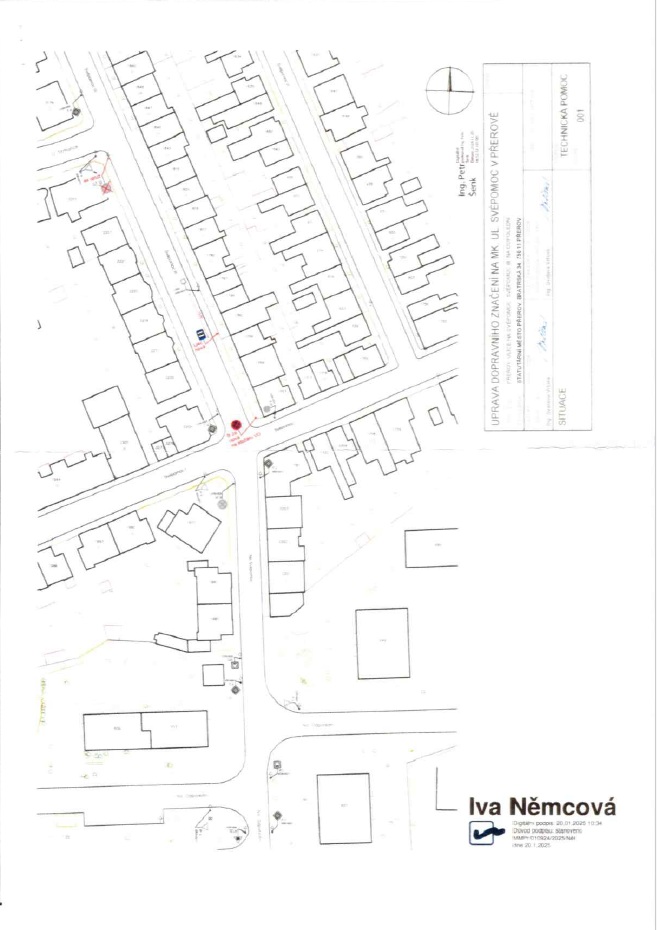
Under Act No. 106/1999 Coll. (freedom of information) we initially received a completely illegible A4 printout — and right at the beginning of the case the 106/1999 procedure was effectively ignored. After complaints and a repeated FOI request under Act 106/1999, pointing out that you simply cannot read a technical drawing shrunk from A2 to A4, the response was once again passive‑aggressive: the request was ignored and no legible copy was provided.
Shifting the “No stopping” restriction from one side of the street to the other only increases the danger when carrying supplies. People now have to cross the carriageway, because the basements are on our side of the street (on the opposite side they are practically non‑existent), where originally no ban was in place. The restriction used to be on the opposite side — and we agreed with that, because the recessed ramped bollards are on our side. The infrastructure has been built the wrong way round, and it is brand new, paid for in the order of hundreds of thousands of crowns.
Autor: Tomáš Kácel
Date: 29.04.2026